More interested

We are more interested in creating projects than fearing the risk of failure.

We are more interested in playing the long game instead of playing the short game.

We are more interested in right relationship than any relationship.

We are more interested in creation than consumption.

We are more interested in editing than adding.

We are more interested in rest than saying we were busy.

We are more interested in writing than being read.

More interested in documenting cloud textures than wanting to get off the plane.

Nos interesa más crear proyectos que temer el riesgo del fracaso.

Nos interesa más jugar a largo plazo que a corto plazo.

Nos interesa más la relación correcta que cualquier relación.

Nos interesa más crear que consumir.

Nos interesa más editar que añadir.

Nos interesa más descansar que decir que estamos ocupados.

Nos interesa más escribir que ser leídos.
What's at the center?

Is it stillness?

Is it competence?

Is it love?

Is it quiet?

Is it community?

I am reading Thoreau’s Journals, and he reminds me that truth is always paradoxical.

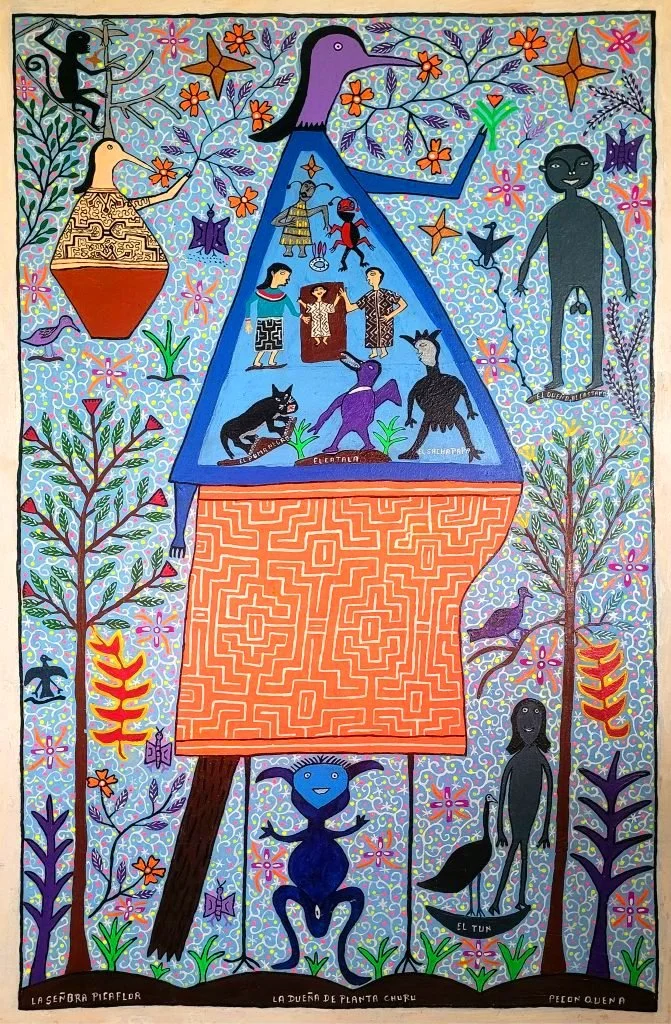
The work of Shipiba artist Lastenia Canayo invites me to consider the spirits of humans and non-human humans in her piece below featuring the hummingbird.

What is seen and unseen in the landscape of memory?

Also, is the center composed of complexity?

Lastenia Canayo depicting the Spirit of the at “Gente Planta Gente Humana Gente Animal. Thanks to the amazing work of Bufeo.

Qué hay en en centro?

¿Es quietud?

¿Es competencia?

¿Es amor?

¿Es tranquilidad?

¿Es comunidad?

Estoy leyendo los Diarios de Thoreau, y él me recuerda que la verdad es siempre paradójica. La obra de la artista shipiba Lastenia Canayo me invita a considerar los espíritus de los humanos y de los no humanos en su pieza de abajo protagonizada por la señora picaflor.

¿Qué se ve y qué no se ve en el paisaje de la memoria?

Además, ¿está el centro compuesto de complejidad?

Hugging Parasite

I am amazed at how closely we hold on to energy-sucking parasites. I’m not judging, just noticing.

We hold on even tighter when we know something isn’t working. The sunk cost fallacy makes it too hard for humans.

I see this a lot. When something appears to not work, we lock down. Our fear of loss is far greater than our desire for gain. It kicks in. It’s hard to let go.

Instead of grasping more tightly on something, we could consider opening our fingers.

See what happens.

That which is ours will return to us—that which isn’t will keep on its venture in the world.

Beautiful parasitic vine

Me asombra lo mucho que nos aferramos a los parásitos chupadores de energía. No estoy juzgando, sólo observando.

Nos aferramos aún más cuando sabemos que algo no funciona. La falacia del coste hundido se lo pone muy difícil a los humanos.

Lo veo a menudo. Cuando algo parece no funcionar, nos bloqueamos.

Nuestro miedo a perder es mucho mayor que nuestro deseo de ganar. Se activa. Es difícil soltar.

En lugar de aferrarnos con más fuerza a algo, podríamos plantearnos abrir los dedos.

A ver qué pasa.

Lo que es nuestro volverá a nosotros; lo que no, seguirá su aventura en el mundo.